Outgrowing gear in puppyhood: realistic expectations
This article is intended for guardians of puppies who are considering purchasing collars, harnesses, or other equipment and are wondering how long that gear will realistically last, and whether it can truly “grow together with the puppy.”
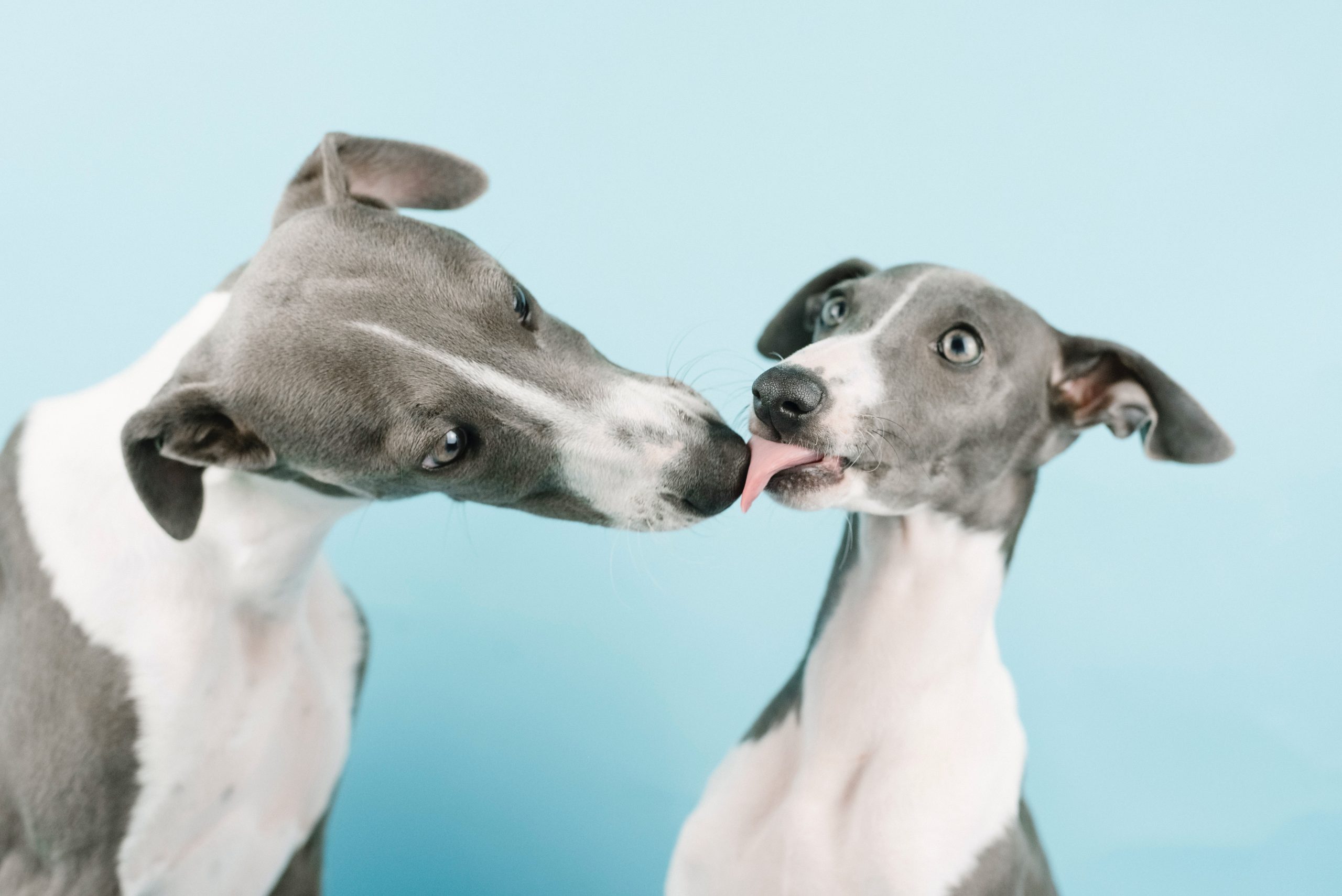
From the very beginning, Galgina has focused on creating equipment for adopted sighthounds. In the vast majority of cases, adopted sighthounds are adult dogs of medium to large size. At the time, there was a lack of equipment on the market that would fit their specific body shape while also providing an adequate level of safety. Equipment for smaller, less demanding dogs has long been more widely available and easily accessible in standard pet stores, which is why we did not focus our development efforts in that direction.
Those early beginnings strongly shaped our path and influenced our current range. We developed and adapted our production processes, sourced suppliers for specific components, materials, machinery, and other equipment, and through experience came to understand both our capabilities and technical limitations. We also came to terms with the fact that we cannot meet every expectation.
The manufacturing process and the properties of finished products can vary significantly depending on their size. In most cases, it is simply not possible to produce all sizes of a product using the same machines, processes, and materials. A product that is perfectly compact for a large greyhound may, in a size suitable for a young whippet, be unnecessarily bulky and stiff.
Over time, Galgina also attracted guardians of smaller or younger dogs, which brought several new challenges. One of the biggest, and for now insurmountable, challenges remains puppies outgrowing their equipment, along with the (overly) high expectations of their guardians.
Growing up
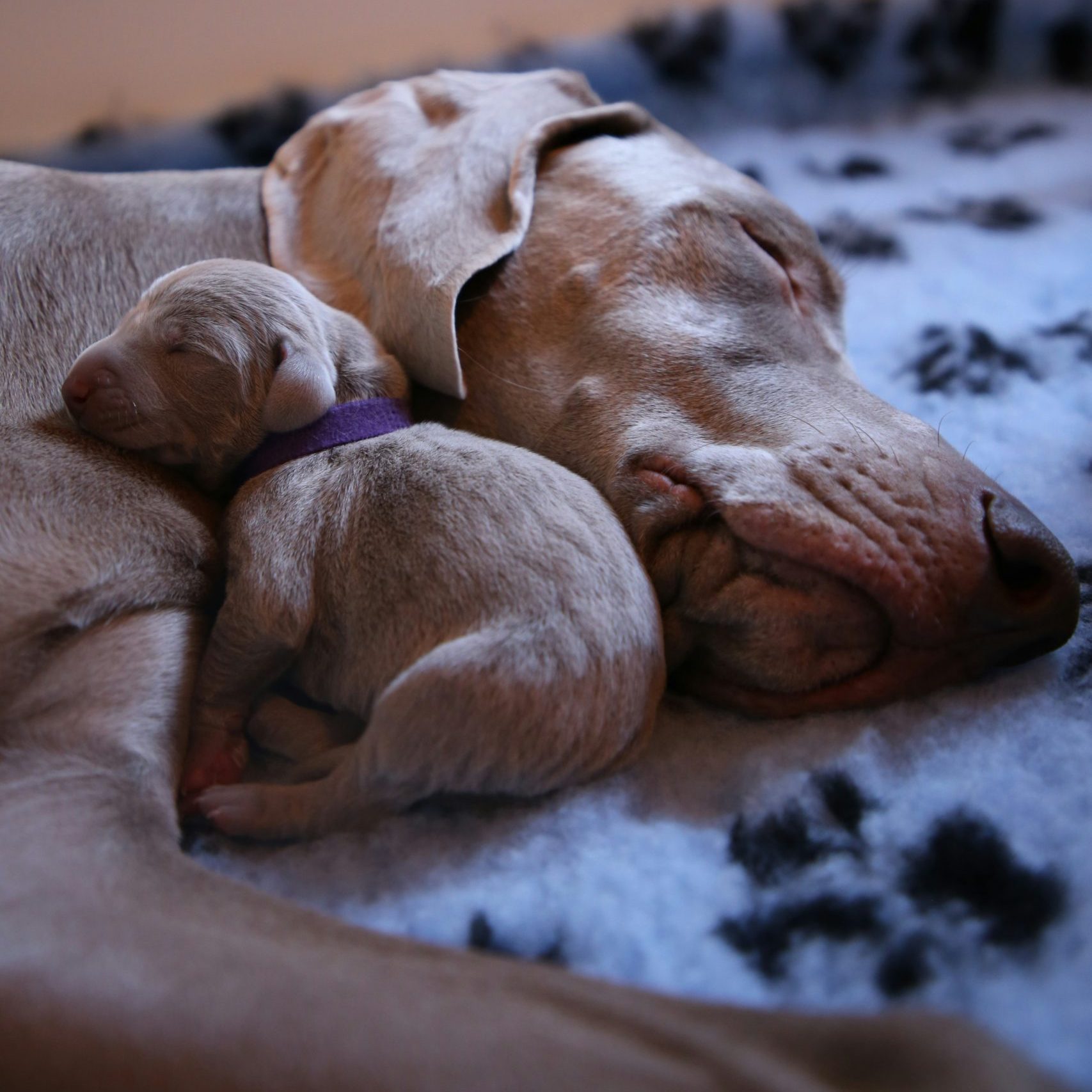
Puppies of all breeds and sizes, of both sexes, grow from birth until adulthood—they gain in both size and weight. Growth is fastest and most noticeable in younger puppies, roughly up to six months of age. In older puppies, growth slows somewhat but continues until around one year of age.
Some puppies can reach up to half of their adult size within the first few months after birth. Growth is also fairly unpredictable, especially when the puppy’s ancestry is unknown. It depends on many factors, making it impossible to say with certainty how large or heavy a dog will be once fully grown.
Smaller dogs generally mature faster, meaning they reach their final size sooner, while larger dogs take longer to mature. Even after reaching their final height and body length, a dog’s body continues to develop and change for some time. Until two or even three years of age, young dogs gain muscle mass, and their chest deepens, a change that is particularly pronounced in sighthounds.
For pedigree dogs, breed standards provide a rough framework of expectations, but in practice, these ranges can be very broad, certainly too broad to accurately predict the final size of an individual dog based on breed and lineage alone, let alone the correct size of equipment.
And yet, one question comes up again and again: collars and harnesses are adjustable, so why shouldn’t they grow along with our puppy?
Adjustability
Adjustability refers to the size range within which the end user can modify a product. This range is always limited; it is never arbitrary and can never be infinite, despite this being a common misconception among dog guardians. The smaller the product is to begin with, the smaller the range within which it can be adjusted.
To make this easier to imagine, let’s look at an everyday example. Socks are elastic, right? And the same pair of socks can fit people with differently sized feet. But a five-year-old child and their forty-year-old father are unlikely to be able to share the same pair comfortably. The child may be able to put on the father’s socks, but they will be neither comfortable nor functional. Inside shoes, this would very likely lead to painful blisters.
Adjustability is primarily intended to allow the product to be put on, taken off, or adjusted so that it is as comfortable as possible for the dog. A puppy’s weight and coat can fluctuate, and the dog may also be wearing clothing underneath the equipment.
With Galgina products, adjustability is possible on circumferences that encircle a specific part of the body, not on lengthwise sections that span between two different points on the body. When designing equipment for adult dogs, we aim to allow guardians to both reduce and increase adjustable sections as needed. For growing puppies, however, we try to ensure that most of the adjustability is oriented toward increasing size, as we assume the body will continue to grow in all dimensions until maturity.
This does extend the usable lifespan of a product, but adjustability is still limited for every item. It is also important to note that dogs outgrow non-adjustable parts and dimensions of equipment as well, especially in more complex products such as sighthound harnesses. In such cases, the optimal fit can quickly be lost, meaning the equipment no longer fits the puppy properly, even if some adjustable straps have not yet reached their maximum length.
Customer requirements
Customers ordering equipment for growing puppies often express a wish for products that would fit their dog from the earliest stages all the way through to full maturity. Unfortunately, we cannot always meet this wish, not because we are unwilling, but because it is simply not feasible, even when producing custom-made equipment. As this article has shown, puppies grow and change continuously, while equipment always has its limitations.
An exceptionally skilled tailor can make you a custom-fitted jacket that fits you perfectly. But that does not mean it will also fit the rest of your family, even if you are related and share a similar build.
For every product in our range, we have researched and defined the extreme limits, especially the smallest sizes in which we can still manufacture them while preserving the desired properties. In each product description, customers can find information about the minimum measurements or weight for which production is possible and for whom the product is suitable.
As a result, there are dogs for whom our products will never be suitable, dogs for whom we cannot produce equipment at all, or dogs whose equipment will need to be replaced (sometimes multiple times) as they grow.
Making the most of equipment
When purchasing equipment that will only fit a puppy for a short period of time, or that the puppy might even chew up, it is entirely understandable that guardians want to spend less money than they would on equipment intended for long-term use. It is the guardian’s role to consider how much a particular piece of equipment is worth to them, especially in terms of which features are most important at a given stage of the puppy’s development. The balance between price and other features is inherently subjective.
Guardians whose primary concern is that the equipment will also fit the dog in adulthood often ask when a puppy reaches the size or age at which they are unlikely to outgrow it. As a general rule, the larger the dog’s expected adult size, the older the puppy should be before ordering equipment intended for use in adulthood.
Approximate ages at which puppies are unlikely to outgrow their equipment are:
Collars
- smaller sighthound breeds, smaller podencos, smaller lurchers: 6–8 months
- larger sighthound breeds, larger podencos, larger lurchers: 8–10 months
Harnesses
(the Basic model is often usable for longer than the Comfort model)
- smaller sighthound breeds, smaller podencos, smaller lurchers: 8–9 months
- larger sighthound breeds, larger podencos, larger lurchers: 9–12 months
Leashes
Leashes are not outgrown, except in cases where you wish to switch to larger or stronger carabiners, or replace a leash as part of a matching set with other pieces of equipment.
From a production cost perspective, neither the size of a product nor the length of time it will be used is a determining factor. We invest the same amount of time and effort into every item. In fact, producing small pieces of equipment often requires more time and is more demanding than making larger ones. For this reason, our products are priced the same regardless of size.
Conclusion
When it comes to equipment for puppies, there is unfortunately no universal solution that truly grows together with the dog. Puppies truly grow an enormous amount in a very short period of time. Just imagine how often you would have to buy new clothes if a newborn child reached adulthood within a single year. Outgrowing equipment is not the exception; it is the rule. Our role is to create equipment that is safe, functional, and comfortable at a given stage of the dog’s life; the guardian’s role is to accept that a puppy will inevitably outgrow certain pieces of equipment. We communicate this openly and transparently with our customers. Realistic expectations are therefore key to satisfaction, both for the guardian and for the manufacturer.